

Rent a house
Renting a property isn't just about choosing the right tenant, it's also about identifying the most tax-effective contractual arrangement. In Italy, the taxation of rental income varies based on the type of contract chosen, particularly between free rent and agreed-upon rent. Each of these options offers different rates, specific benefits, and different impacts on the return on your real estate investment. In this section, we analyze the main tax differences between the two solutions to help you make an informed choice that best suits your needs.
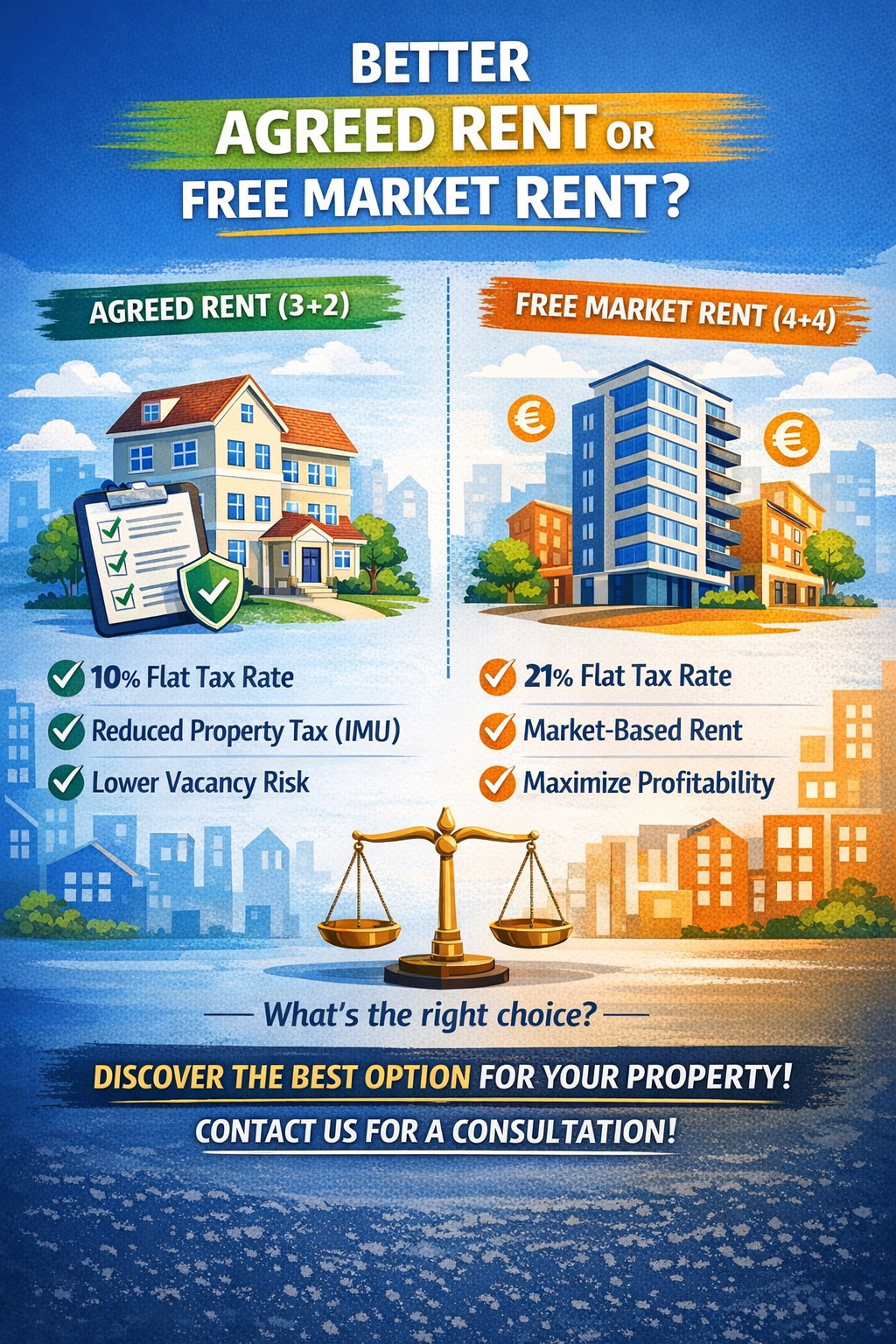
The 21% rate applies to the following contracts:
- free-market rental contracts provided for by Law no. 431/1998 (Article 2, paragraph 1), with a duration of 4+4 years;
- rental agreements governed by the Civil Code (Article 1571 et seq.), not falling within the scope of Law 431/1998;
- rent-based contracts stipulated in municipalities that are not among those with high housing tension;
- tourist rentals and short-term rentals relating to a single apartment;
- rental contracts for category C/1 properties (up to 600 m2) signed exclusively during 2019.
The reduced rate of 10% applies to specific types of contracts, including:
- agreed-upon rental agreements (3 + 2), entered into pursuant to Law No. 431/1998, relating to homes located in municipalities with a housing shortage, in municipalities with high housing tension identified by the CIPE, and in municipalities bordering those with high housing tension;
- rental agreements entered into within the deadlines established by law, in municipalities for which a state of emergency has been declared following natural disasters, and in the absence of specific territorial agreements, it is possible to refer to the agreements in force in the nearest demographically homogeneous municipality, even if located in another region;
- agreed-upon rental agreements entered into to meet the housing needs of university students, based on the national agreements established by law (the tax relief does not apply to contracts entered into under the free-rent model);
- transitional contracts lasting between 1 and 18 months, provided they are stipulated at an agreed rent and concern properties located in municipalities with a housing shortage or high housing tension.
Municipalities considered to be highly housing-stressed include Bari, Bologna, Catania, Florence, Genoa, Milan, Naples, Palermo, Rome, Turin, Venice and their neighboring municipalities, provincial capitals, and other municipalities identified as high housing tension by specific resolutions of the CIPE (Interministerial Economic Planning Committee).
In general, an agreed rent is advantageous if the rent you can obtain is lower than the unrestricted rent by NO more than 10–12% compared to what you could obtain with an unrestricted rent contract. This is because the tax benefits (flat-rate tax and IMU discount) offset the difference in rent.